Board games · Rules and play
When Go ends: area scoring and the site’s confirmation steps
Understand consecutive passes, dead-group review and mutual agreement. Calculate a complete 9×9 example with komi and distinguish this site’s area scoring from Japanese territory scoring.
Published: · Updated:
Passing does not itself declare a winner. On this site, two consecutive passes open score review, where dead-group markings and totals must be checked. Understanding that sequence helps you avoid treating the capture counter as the final score or accepting an unsettled position too quickly.
Two passes open review
You may pass on your turn when you have no further placement to make. If the opponent places a stone after your pass, the consecutive-pass count is broken. When both players pass in succession, play stops for score review. The winner has not yet been finalised.
Inspect unresolved fights and boundaries before agreeing. A disputed group does not become settled just because both players passed. If you need to test its status through play, the review controls let you resume. Agreement should follow a check of the board and dead-group markings.
Check dead and unresolved groups
Dead stones are those removed for the agreed scoring position. In the site’s review display, × marks a dead group and ? marks an unresolved group. A question mark is not an assurance that the stones are alive. Tap a group to change its dead marking. Any such change cancels both players’ previous approvals.
Check the display even when CPU analysis supplies markings. If you disagree, resume play. Resuming cancels scoring removals, retains the original stones, and continues from the next side to move. A provisional total for disputed markings is not a completed result.
Count living stones and enclosed empty regions
After removing marked dead stones for scoring, the site counts each colour’s remaining stones plus empty regions bordered by that colour alone. An empty region touching both colours is neutral and scores for neither. Captures are recorded, but they are not added separately to the total.
White also receives komi. Here it is 7.5 in even 9×9 and 13×13 games, 6.5 on 19×19, and zero with handicap stones. These are the site’s adopted settings. Japanese rules compare territory using prisoners; that calculation differs from the area method used here. Do not interpret the site’s total as a Japanese territory score.
Calculate a complete 9×9 example
Construct a 9×9 board with Black filling its top four rows, White its bottom four rows, and the middle row empty. Leave just two holes in Black’s block at (2,2) and (2,4), and two in White’s block at (7,6) and (7,8). Coordinates mean row from the top, then column from the left. Each large connected group has two separate internal empty points. For this example, both sides agree all stones are alive and no stones are dead.
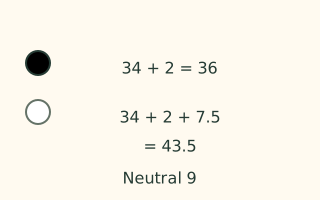
Black has 34 stones and two enclosed empty points: 36. White also has 34 plus two: 36. The nine empty intersections in the middle row touch both colours, so they are neutral. In an even 9×9 game, add White’s 7.5 komi. White has 43.5 against Black’s 36 and wins by 7.5. The figure summarises the arithmetic rather than drawing the board.
Both sides confirm the result
After checking totals and removed groups, agreement from both colours finishes the game. One approval leaves it in review. If a marking changes, both sides must approve the revised position again. This makes the confirmation refer to the markings actually being counted.
In CPU play, conflicting markings can lead to another analysis, resumed play, or a displayed option to review the markings manually. If you are uncertain, resume and resolve the shape. Scoring compares the area left at the end; it is not simply a contest to accumulate captures.
Questions and answers
Do captured stones add points directly?
Not in this site’s area variant. It counts remaining stones plus empty regions bordered by one colour, then adds White’s adopted komi.
Can I continue after two consecutive passes?
Yes, during score review you can resume play. The original stones remain, and scoring dead markings and approvals are cancelled.
References
- 日本棋院 日本囲碁規約 第十条逐条解説
Checked: - Rules on this site
Checked: - Rules on this site
Checked: