Board games · Rules and play
Go liberties and captures: count the whole group
Follow a one-stone capture, recognise atari and count shared liberties. Learn why capture is checked before suicide and how the site’s positional superko differs from a basic ko explanation.
Published: · Updated:
In Go, a surrounded group is removed from the board when it loses every liberty. The important question is how many adjacent empty intersections remain for the whole group. A small position makes the order of a capture easier to understand before you try reading a crowded board.
Count orthogonal empty neighbours
A liberty is an empty intersection directly above, below, left or right of a stone. An isolated stone can have at most four in the centre, three on an edge, and two in a corner. Diagonal empty intersections do not count, and there are no liberties outside the board.
Stones of the same colour connected horizontally or vertically form one group. Count the distinct empty intersections adjacent to that group. If two stones touch the same empty point, it is still one liberty. Stones that touch only diagonally remain separate groups for capture purposes.
Black fills the last liberty
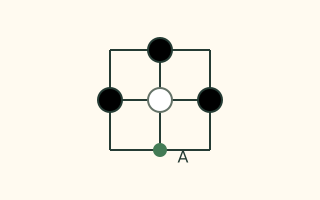
The diagram is a constructed central crop of a 9×9 board. Coordinates here mean row from the top, then column from the left. White is at (5,5); Black is at (4,5), (5,4) and (5,6). Green A is empty (6,5). Every other intersection on the full board is empty. It is Black’s turn, and the resulting board has not appeared before.
Inspect the white stone’s four orthogonal neighbours. Three contain Black, leaving only A empty. A group with one liberty is in atari. Black plays A, removing that last liberty, and takes the white stone. The former white point (5,5) becomes empty, so the newly placed black stone has a liberty after capture.
Recount after a rescue
An endangered group might extend into an empty point, connect to friendly stones, or capture an adjacent enemy group. Adding a stone does not automatically make the group safe. Recount the liberties of the resulting connected group, rather than counting each stone separately.
For comparison, suppose it were White’s turn in the original diagram and White extended to A. With all other points empty, the two-stone group would have three liberties: (6,4), (6,6) and (7,5). This comparison changes the side to move. It does not suggest that White may play on occupied A immediately after Black’s capture.
Remove captured enemies before checking suicide
A point surrounded by opposing stones may still be playable if placing a stone there captures those neighbours and opens liberties. Check in this order: place the stone, remove opposing groups with no liberties, then count the new friendly group’s liberties. The final board matters.
This site prohibits a placement that still leaves your group without liberties after enemy captures. Empty does not always mean legal. The Nihon Ki-in’s introductory rules likewise distinguish a placement without an escape route from a capturing placement that opens one.
Ko and the site’s repetition rule
A basic explanation of ko says that you cannot immediately recapture to recreate the same position. This site applies positional superko: a stone placement cannot produce any earlier board arrangement, regardless of whose turn it was. Checking only the previous capture is therefore not sufficient for a longer repeating cycle.
The same group and liberty logic applies on the site’s 9×9, 13×13 and 19×19 boards. Before choosing a point, inspect both colours’ liberties: pursuing a capture can expose another group. Passing is available, but two consecutive passes lead to score review. The final result belongs to that later confirmation step.
Questions and answers
Are diagonally touching stones one group?
No. Capture groups are connected horizontally or vertically. Count the empty orthogonal neighbours of each group.
Is an empty point surrounded by enemies always illegal?
No. Capturing those enemies may open liberties. This site still prohibits suicide after captures and a placement recreating any previous board.
References
- 日本棋院 囲碁ってなあに?
Checked: - Rules on this site
Checked: - Rules on this site
Checked: