Puzzles · Rules and play
Sudoku is about distinct symbols: why relabelling preserves logic
A one-to-one change of digit labels preserves Sudoku constraints. Use that fact to see why repetition, rather than arithmetic, drives deductions.
Published: · Updated:
A one-to-one change of digit labels preserves Sudoku constraints. Use that fact to see why repetition, rather than arithmetic, drives deductions.
Repetition matters more than size
Using the digits 1 through 9 can make Sudoku look like an arithmetic puzzle. Its ordinary rule, however, is to put nine distinct digits once each in every row, column and 3×3 box. There is no special requirement to place 9 beside 8, and using 1 early offers no inherent advantage. Choose what to investigate by how restricted its possible locations are, rather than by numerical size. The site detects conflicts by looking for equal digits in a shared unit. Understanding that equality test helps separate the actual rule from habits suggested by the appearance of numbers.
Swap every 1 and 9
Take a completed board and replace every 1 with 9 and every 9 with 1, leaving the other digits unchanged. Each row originally had one of each, so it still has one of each after the swap. The same reasoning applies to columns and boxes. The changed board therefore also obeys the rules. To transform a puzzle consistently, relabel its givens, entries, solutions and candidate lists by the same rule. Changing just one cell is a different action and can introduce a conflict. This is a thought experiment for understanding the rule; the site’s actual input pad continues to use 1 through 9.
The mapping must be one-to-one
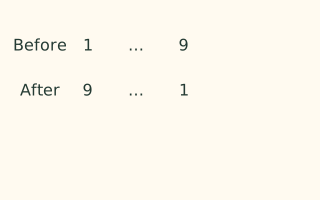
The diagram shows a completed row, 1 2 3 4 5 6 7 8 9, with 1 and 9 exchanged. A one-to-one correspondence to nine distinct labels preserves which entries differ. A mapping that sends both 1 and 2 to A does not work: two different digits collapse to one label, losing the distinction needed to detect repetition. A valid row alone does not establish a valid board made of arbitrary rows. For the whole-board argument, start with a board that satisfies all units and apply the same one-to-one mapping everywhere, including every column and box.
Candidate deductions move with the labels
The same mapping carries candidate deductions across. If a cell can contain only 1, swapping 1 and 9 throughout the puzzle leaves it able to contain only 9. A pair restricted to 1 and 4 becomes a pair restricted to 9 and 4. The spatial relationships remain unchanged; only the names of forbidden and allowed digits change. Because the swap has an inverse, complete solutions of the original puzzle correspond one-to-one to complete solutions of the transformed puzzle. Uniqueness, or the number of solutions, is therefore preserved. This conditional argument does not assert that the partial row in the diagram has a unique completion.
Use the idea while solving
When stuck, reread a digit as a label and ask where that label can go. There is no reason to postpone 9 merely because it is large. Make accurate notes and enter a label when only one location remains. Checking that each row adds to 45 is insufficient: a row with repeated digits can have that same total. The site’s completion check requires every cell to be filled and every row, column and box to contain nine different values. Keeping that distinctness goal in view directs attention toward candidates and unit relationships that actually justify a move.
Questions and answers
Is there a letter mode on this site?
The relabelling here is a thought experiment. The current site uses a number pad from 1 through 9.
Is a row correct if its sum is 45?
The sum alone is insufficient. Check that each digit from 1 through 9 occurs once without repetition.
References
- Rules on this site
Checked: - Rules on this site
Checked: