Puzzles · Ideas and tactics
Sudoku candidates: one digit or one possible place
Build candidates from rows, columns and boxes, then distinguish a single remaining digit from a single possible location.
Published: · Updated:
Build candidates from rows, columns and boxes, then distinguish a single remaining digit from a single possible location.
Use all three units
Each row, column and 3×3 box must contain the digits 1 through 9 once each. For an empty cell, remove every digit already present in any of those three units. Looking at the row alone can leave digits that its column or box forbids. A candidate means a digit that does not directly conflict with the current entries, not a digit that is guaranteed to appear in a completed solution. Check your own entries as well as the givens before using them to exclude candidates. A mistaken entry can make an otherwise careful candidate list misleading.
One candidate in one cell
Suppose a row already contains 1, 2, 3, 4, 5 and 6, leaving three empty cells A, B and C. If A’s column or box contains both 8 and 9, A has only 7 left. The row excludes 1 through 6 and the other units exclude 8 and 9. This is a single candidate in a cell: examine one cell and eliminate eight digits. Without more conditions, the example does not decide whether B or C receives 8. It also makes no claim about the number of complete solutions for an entire Sudoku board.
One location for a digit
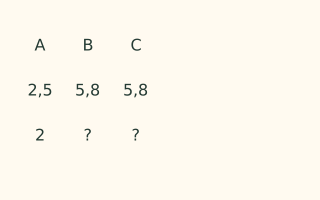
In a different row, suppose the missing digits are exactly 2, 5 and 8. The complete candidate lists for its empty cells are A: 2 or 5, B: 5 or 8, and C: 5 or 8. A has two candidates, yet it is the only place in the row that can contain 2. Since the row must contain 2, A is forced to 2. B and C still exchange 5 and 8. This is a single location for a digit. In addition to reading each cell, count the possible places for each missing digit within a row, column or box.
Manage notes on this site
With Notes ON, select an empty cell and press a digit to toggle that note. Entering a normal digit clears the cell’s notes and removes that digit from notes in its row, column and box. Erasing an entry does not reconstruct every candidate that was removed earlier, so review those three units again. Fill candidates (replace notes) rebuilds lists from the current entries. It replaces your existing notes, including exclusions you may have worked out through more advanced reasoning. This action marks the record assisted. Use it with that replacement behaviour in mind rather than treating the notes as permanent evidence.
Pairs and the next deduction
If two cells in the same unit each have exactly the same two candidates, such as 2 and 5, those cells reserve both digits. Other cells in the unit cannot use either. Incomplete handwritten notes do not establish that condition; verify the complete candidate lists first. The site’s Hint explains singles, single locations and pair-based deductions. It may find no next deduction, and Reveal one answer is a separate option. Before revealing an answer, try naming the unit and what has become unique: one digit for a cell, or one cell for a digit. That makes the reasoning easier to repeat.
Questions and answers
Should I guess when a cell has two candidates?
First count possible locations for each digit in its row, column and box. A digit with one possible location can still be forced.
Does automatic candidate filling only add to my notes?
No. It rebuilds candidates from current digits and replaces the existing notes.
References
- Rules on this site
Checked: - Rules on this site
Checked: - Rules on this site
Checked: