Board games · Rules and play
Shogi piece moves: direction, distance and blocked paths
Learn the eight shogi pieces by direction and distance. Compare gold and silver moves, follow a rook capture step by step, and distinguish movement from legal play.
Published: · Updated:
You do not need to memorise every symbol before making sense of shogi. For each piece, ask which way is forward, how far it may move, and whether another piece blocks its path. These questions explain most ordinary moves. King safety then tells you whether a geometrically possible move is legal in the position.
Forward belongs to the owner
Shogi uses a board of nine rows and nine columns, with the first player making the opening move. Forward means toward the opponent from the piece owner’s point of view. The two sides therefore face opposite directions. Flipping the displayed board changes your view, while each piece keeps its own forward direction.
An unpromoted pawn advances one square straight forward. A lance travels any distance straight forward through an unobstructed path. Neither retreats. A knight jumps two rows forward and one column left or right. It can jump over an intervening piece, but cannot jump sideways or backward.
Gold and silver differ behind the piece
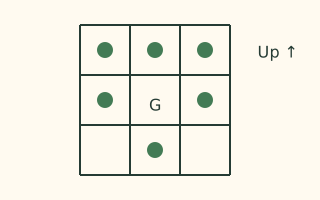
A gold moves one square in any of the three forward directions, directly left or right, or straight backward. A silver moves one square in the three forward directions or either backward diagonal. Gold cannot retreat diagonally; silver cannot move directly sideways or straight backward. Those missing directions often matter more than the shared ones.
The diagram isolates an upward-facing gold. Assume its eight surrounding squares are empty and no king-safety restriction applies elsewhere. The green dots show its six possible destinations. In a real position, a friendly piece on a marked square would still prevent that move.
Rook, bishop and king
A rook travels horizontally or vertically; a bishop travels diagonally. Both can move any distance, but neither can jump over another piece. The lance follows the same blocking rule along its forward line. A friendly piece blocks the destination. An opposing piece can be captured on the first occupied square, but stops travel beyond it.
The king moves one square in any of the eight directions. A king cannot enter an attacked square. When considering a capture, assess the position after the captured piece has been removed: a piece behind it might then attack the king.
Trace a rook capture
Imagine the first player’s unpromoted rook on 5h, an opposing pawn on 5e, and empty squares at 5g and 5f. No other piece lies between rook and pawn. Assume your king is safe and moving this rook will not expose it to check. The letters label rows a–i from the first player’s top side.
First, 5h to 5e follows a vertical line, so the direction suits a rook. Second, inspect 5g and 5f: both are empty. Third, move to 5e and capture the pawn. It joins your hand for a later turn. You cannot instead move to 5d in this position, because that would jump over the pawn on 5e.
Use the site’s legal destinations
This site’s standard shogi implementation uses these movements. Select a piece to see legal destinations, then select a destination. If both promotion choices are legal, choose whether to promote. The markers account for king safety and prohibited moves as well as the piece’s movement pattern.
When checked, consider moving the king, capturing the checking piece, or blocking a long-range attack where possible. Each reply must remove the check. Start by learning forward movement with pawns and golds, then practise tracing rook paths. This gives you a repeatable way to read unfamiliar positions without treating every highlighted square as an unexplained hint.
Questions and answers
Can a knight land on a friendly piece?
No. It may jump over intervening pieces, but its destination cannot contain a friendly piece.
Why is a move unavailable even when the piece moves that way?
A move must also keep your king safe. A move that leaves or places your king in check is illegal.
References
- 日本将棋連盟 対局規則
Checked: - Rules on this site
Checked: - Rules on this site
Checked: