Puzzles · Ideas and tactics
Nonogram lines: overlap, gaps and crossing clues
Compare legal placements in one line, mark only shared conclusions, and carry them across to the crossing columns.
Published: · Updated:
Compare legal placements in one line, mark only shared conclusions, and carry them across to the crossing columns.
Clues describe ordered runs
A nonogram clue gives the lengths of consecutive filled runs in their order. A row clue of 2 1 means a two-cell run followed by a one-cell run, with at least one empty cell between them. It does not permit filling any three cells merely because the digits add to three. Read column clues in the same way from top to bottom. Add the run lengths and the minimum required separators to find the smallest space the clue needs. Compare that total with the line length to see how much room remains for shifting the runs or adding empty cells.
A run of 3 in five cells
Take a completely unmarked five-cell row with the single clue 3. The run can start in cell 1, 2 or 3, giving filled ranges 1–3, 2–4 and 3–5. Only cell 3 appears in every placement, so the centre is certainly filled. Cells 1, 2, 4 and 5 can each be filled in some placements and empty in others. Leave them unresolved. Comparing the leftmost and rightmost placements exposes the common centre. This conclusion comes from the row alone. Crossing columns or additional marks are needed to settle the remaining cells; overlap does not solve the full picture by itself.
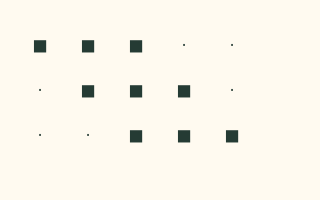
Count the separator for 2 and 1
For a five-cell line with clue 2 1, the minimum is four cells: two filled, one empty separator and one filled. Writing filled cells as ■ and empty cells as ·, all possibilities are ■■·■·, ■■··■ and ·■■·■. Cell 2 is filled in every placement. Cell 4 is filled only in the first, so it cannot yet be fixed. If you force the separator to be exactly one empty cell, you miss the second placement. The rule says at least one empty cell between runs. Extra space may appear before, after or between them, so account for all legal choices.
Pass empty and filled facts across
A proven filled cell becomes a constraint in its crossing column. Proven empty cells matter just as much. If every remaining placement leaves a cell empty, mark it as an empty note. Do not automatically cross off both ends of a run just because it looks complete. First establish which clue the run belongs to and that it has reached its required length. When empty cells split a line into segments, reconsider which clue runs can fit in which segments. Move a deduction from row to column, then carry new column information back to the rows. This repeated exchange steadily reduces the placement choices.
Separate fill, empty notes and unknowns
Choose Fill, Empty note or Erase, then tap or drag cells on this site. An empty note records a conclusion and differs from an unmarked cell you have not resolved. Erase returns a cell to unknown; it does not assert that the cell is empty. Clicking a clue to mark it checked is also a manual bookkeeping action, not a correctness test. Hint with a reason examines placements consistent with the clues and current marks, and lets you read the explanation before applying it. If a row or column conflicts with your marks, review that line and erase or undo a doubtful conclusion.
Questions and answers
Are Empty note and Erase the same?
No. Empty note records an empty-cell conclusion; Erase returns the cell to unresolved.
Does overlap prove that the whole puzzle is unique?
No. It establishes only cells shared by the legal placements in that line. The full board also needs every column constraint.
References
- Rules on this site
Checked: - Rules on this site
Checked: