Puzzles · Ideas and tactics
Reading Minesweeper numbers: neighbours and subtraction
Count diagonal neighbours, separate facts from flags, and compare overlapping clues to find a safe square.
Published: · Updated:
Count diagonal neighbours, separate facts from flags, and compare overlapping clues to find a safe square.
What a number counts
An open square counts mines in the surrounding horizontal, vertical and diagonal squares. It does not count itself or squares two steps away. A corner has three neighbours; an interior square has eight. Before making a deduction, trace exactly which covered squares touch the clue. A 1 beside one unknown square gives more information than a 1 beside three unknown squares. Do not subtract a distant flag just because it is nearby on the screen. The flag must be inside this particular clue’s neighbourhood, and its placement must already have a sound reason.
Two basic deductions
Subtract the number of proven mines around a clue from the clue itself. The result is the number of mines still required among its unresolved neighbours. If the result is zero, those unresolved squares are safe. If it equals the number of unresolved squares, every one is a mine. For example, a 2 with one proven mine and exactly one unresolved neighbour forces that neighbour to be a mine. A flag is a player’s mark, so counting flags alone is not a proof. Check the deduction behind each flagged square before using it as a fact in another calculation.
Compare a 1 and a 2 at the top edge
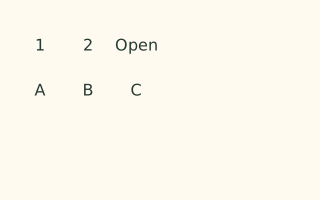
Consider two open clues on the top edge, a 1 immediately left of a 2. The only unresolved neighbours of the 1 are A directly below it and B below the 2. The only unresolved neighbours of the 2 are A, B and C, with C diagonally below and to its right. Every other neighbour is open. The first clue says A and B contain one mine in total. The second says A, B and C contain two. Subtraction forces C to be a mine. It does not tell us which of A and B is the other mine. Keep that remaining uncertainty visible.
A safe first move and what follows
On this site, the first revealed square and its neighbours contain no mines. That creates a zero opening and some visible clues to work from. This protection applies to the opening area; it does not make later choices safe. Random boards can reach positions where the visible clues do not establish a certain next move. No guessing mode instead prepares a board verified as solvable by the site’s logical procedure from the chosen opening. An attempt can fail to prepare a board, in which case the interface offers retrying or changing the settings. Neither mode makes an unsupported click into a deduction.
When a deduction stops
Return to one clue and sort its neighbours into open safe squares, proven mines and unresolved squares. Writing only that neighbourhood on paper can prevent accidental counting across the board. When comparing two clues, check that the candidate sets actually overlap as claimed. After C is proved in the example, alternately opening A or B would still be a guess. Look for another clue that separates them. The Logical hint button uses visible clues and can help you inspect a deduction, but it can also report that no certain move was found. Using hints marks the record as assisted.
Questions and answers
Does a 1 mean the mine is immediately to the right?
No. It means one mine among all its horizontal, vertical and diagonal neighbours. Several locations can remain possible.
Does this diagram prove a unique complete board?
No. It proves only C from two local conditions. Two placements for A and B remain possible.
References
- Rules on this site
Checked: - Rules on this site
Checked: - Rules on this site
Checked: