Card games · Ideas and tactics
FreeCell group moves: count free cells and usable empty columns
Calculate group capacity with the empty destination excluded, then follow a six-card transfer example.
Published: · Updated:
When a FreeCell group will not move, check temporary space as well as ranks and colors. Hitoiki Arcade calculates the allowed group size from free cells and usable empty columns.
First check the group and destination
A standard deal distributes all 52 cards face up across eight columns: seven cards in each of the first four columns and six in each of the others. There are four free cells, each holding one card. Foundations grow by suit from Ace to King. Stage positions may already have some cards in foundations.
A selected group must run from its selected position to the front of its column, descending in alternating colors. Red eight, black seven, red six can go onto a black nine. Unlike Klondike, an empty FreeCell column accepts a group beginning with any rank. Empty destinations still have a group-size limit, so the absence of a receiving card does not remove every restriction.
Count empty columns except the destination
The capacity is the number of free cells plus one, multiplied by two raised to the number of usable empty columns. A usable empty column is empty before the move and is not the destination. If moving the whole source group will empty its column, that future gap does not count: the source column is occupied when capacity is calculated.
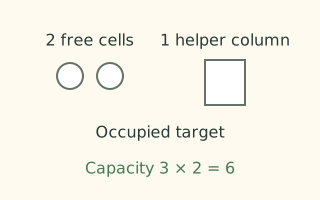
With two free cells and one empty column, a move onto an occupied destination has capacity three times two, or six cards. A move into that sole empty column has no other empty column to use, so its capacity is only three cards. In both cases, the selected group and any receiving card must also satisfy the rank and color rules.
Understand six cards through a transfer sequence
Suppose exactly two cells and one helper column are empty. All other cells and columns are occupied, and the occupied destination ends with a black nine. The source ends with red eight, black seven, red six, black five, red four, black three. All six cards are a legal group and fit the calculated capacity.
Park black three and red four in the two cells, then move black five into the helper column. Put red four onto black five and black three onto red four, freeing both cells. Use those cells to transfer the remaining red eight, black seven and red six onto black nine. Finally, use the cells again to transfer the helper’s black five, red four and black three onto red six. Each individual placement follows the same rank and color rule.
Check the return route before filling a cell
Putting a card into a free cell removes that cell from the next capacity calculation. With no empty columns, reducing the free-cell count from two to one reduces capacity from three cards to two. A convenient single-card parking move can therefore block the three-card transfer you were planning next.
Before parking a card, identify its return destination and the column you hope to clear. Creating a landing place first can make it easier to recover the cell later. A large capacity is permission to move a group of that size; it does not mean such a group exists or that a receiving card is available.
Capacity does not prove a winning continuation
When a group fails to move, check its alternating sequence, the destination, the currently free cells, and empty columns excluding the destination. Cell and foundation moves accept only one card, so a multi-card group cannot bypass capacity by being sent there.
The formula describes this implementation’s move allowance, not a proof that the whole position is solvable. A legal transfer can still cover an important card or consume useful space. Use Undo to compare your use of temporary storage, and evaluate what becomes accessible after the move.
Questions and answers
Does an empty destination increase capacity?
No. It is excluded from temporary storage; only other empty columns count.
Can I count the source column that will become empty?
No. This implementation counts columns that are empty before the move.
References
- Rules on this site
Checked: - Rules on this site
Checked: