Board games · Rules and play
Chess special moves: castling, en passant and promotion
Check why castling is unavailable, when an en passant opportunity expires, and how to choose a promotion piece using concrete positions and site controls.
Published: · Updated:
Three special moves make a chess position depend on more than the arrangement of pieces. The site offers legal destinations and a promotion choice, but understanding the conditions helps you recognise why a familiar-looking move may be unavailable. Use the examples below to connect a rule with a decision on the board.
Select the piece and its destination
Selecting your own piece shows its legal destinations. For castling, choose the king’s destination; for en passant, choose the pawn’s diagonal destination. Promotion adds a choice of the new piece after you select the destination. Only moves meeting the conditions are offered.
If a destination is missing, inspect your king’s safety and the preceding moves as well as the pieces in the way. A legal-move marker says the move is allowed. It does not say that the resulting position is favourable.
Move a king and rook in one turn
White kingside castling moves the king from e1 to g1 and the h1 rook to f1. Queenside castling moves the king to c1 and the a1 rook to d1. Black uses the same files on rank 8.
The king and that rook must be unmoved, the intervening squares empty, and the king’s starting, crossing and destination squares unattacked. Returning a previously moved king or rook to its original square does not restore the right.
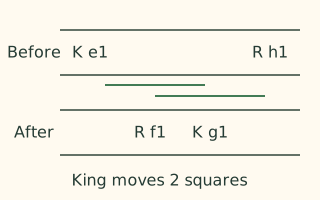
An empty route can still be unsafe
Imagine White’s king on e1 and rook on h1, and a black rook on f8 with f2 through f7 empty. White’s king need not be in check for castling to fail: the black rook attacks f1, which the king would cross. The kingside destination is therefore unavailable.
Blocking that attack may change the position enough to permit castling if the unmoved rights remain. Moving the king to escape an attack has a different consequence: even if it returns to e1, the right is gone. This example separates a temporary obstacle from a lost right.
Use the opportunity on the immediately following move
With a white pawn on e5, suppose Black has just moved a pawn from d7 to d5. If king safety permits, White can move e5 to the empty d6 square and remove the black pawn from d5. The destination and the captured pawn’s square are different.
If White chooses another move, this opportunity expires. A black pawn that has been sitting on d5 cannot later be captured this way. The capture is also unavailable if removing those pawns exposes White’s king. Check both the last move and the resulting open lines.
Choose what the new piece needs to do
A pawn reaching the far rank must become a queen, rook, bishop or knight of its own colour as part of that move. The choice is not limited to previously captured pieces. White promotes on rank 8 and Black on rank 1.
For example, moving a white pawn from a7 to an empty a8 opens the site’s four-piece choice. A queen is powerful, but consider the attacks you need and any stalemate danger. The new piece acts immediately; promotion does not wait for a later turn.
Questions and answers
Does an attacked rook prevent castling?
An attack on the rook alone does not prevent it. Check the king’s three relevant squares, empty route and unmoved rights.
Can I capture en passant whenever a pawn is beside mine?
Only immediately after it advances two squares from its starting square, and only if your king remains safe.
Can promotion create a second queen?
Yes. Choose a queen, rook, bishop or knight without being limited by captured pieces.
References
- FIDE Laws of Chess taking effect from 1 January 2023
Checked: - Rules on this site
Checked: - Rules on this site
Checked: