Board games · Rules and play
Checkmate and stalemate: why an immobile king may draw
Compare two three-piece positions with a black king on a8, check every escape, and learn how checkmate differs from a stalemate draw.
Published: · Updated:
If surrounding a king produced a draw, look at one extra fact: was that king in check? The site records checkmate as a win and stalemate as a draw. Examining a small position makes that difference visible without needing a long sequence of moves.
Start with the king of the side to move
Check means an opposing piece attacks the king’s square. Checkmate requires check and no legal response. Stalemate requires no check and no legal move for the side to move. You do not continue until a king is captured.
A king with no escape is not enough by itself. Another piece may capture the attacker or block a sliding attack. When there is no check, even one legal move by another piece prevents stalemate. Look at the whole side, not just its king.
Work through a three-piece stalemate
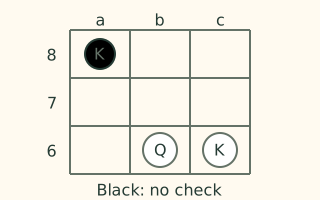
Put only a black king on a8, a white king on c6 and a white queen on b6, with Black to move. The queen does not attack a8, so Black is not in check.
Black’s possible king destinations are a7, b7 and b8. The queen attacks a7 diagonally and b7 and b8 along the b-file. White’s king also protects b7. Black has no other piece to move and no safe king destination. This is stalemate, so the result is a draw.
Compare a queen one square higher
Now consider a separate position: keep the black king on a8 and white king on c6, but put the white queen on b7, again with Black to move. This is a comparison position, not a move played after the previous game ended. The queen now attacks a8 diagonally.
The queen also attacks a7 horizontally and b8 vertically. Black cannot capture the queen on b7 because White’s king on c6 protects it. With no other black piece and no legal answer to check, this position is checkmate for White.
Search for an answer before declaring mate
In a fuller position, search for a safe king move, a capture of the checking piece, and a way to block its line. Any candidate that still leaves your king attacked is illegal. Some attacks, including a knight’s check, cannot be stopped by placing a piece between attacker and king.
The attacker can use the same checklist to look for the opponent’s replies. A check indication alone does not establish mate. Check whether the final attacking piece can be taken or another defender can intervene.
Use the result and the final record position
The site adds a check indication to the turn status and displays the outcome and reason when the game ends. Its chess notation can include + for check and # for mate. Choose Review move record to compare the final board with the preceding position if the notation is unclear.
Having more pieces does not guarantee a win. A final move can remove every opposing legal move without attacking the king, producing a draw. In an endgame, inspect both the king’s check status and all moves available to the side to move. This is a useful check, not a guaranteed winning sequence.
Questions and answers
Is a king with no escape always checkmated?
No. It must be in check, with no legal response by its side. Consider capturing the attacker or blocking the attack.
Does the player who creates stalemate win?
No. Stalemate is a draw: the side to move has no legal move and its king is not in check.
Can another move be played after stalemate?
The game has ended. Review the record and try a different final attack in a separate game.
References
- FIDE Laws of Chess taking effect from 1 January 2023
Checked: - Rules on this site
Checked: - Rules on this site
Checked: